

One of the Torah’s most enigmatic commandments is the mitzvah of the Red Heifer (Parah Adumah in Hebrew). Burned near the Holy Temple, its ashes were mixed with water and used to ritually purify those who had come into contact with a dead body or grave. Read on for 12 facts about the mysterious ritual that left even King Solomon, the wisest of all humans, utterly perplexed.
1. Two Black Hairs Disqualified It
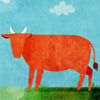
For a red heifer to be kosher, every single hair on its body needed to be red, from head to toe—just two adjacent black hairs were enough to disqualify it! Body parts that don’t grow hair, such as the eyeballs, teeth, and tongue, could be any color.1
One more thing: the heifer wasn’t quite the color you might be imagining. We’re not talking firetruck red here—think more of a reddish-brown.
Read: What Was the Red Heifer?
2. Only Nine Were Ever Used
Perfectly red cows are hard to come by—and color was just one of many requirements. For example, the heifer also couldn’t have any physical blemishes, and it could never have been put to work. According to tradition, only nine such heifers have ever been used: one by Moses, one by Ezra the Scribe, and seven more during the Second Temple period. The tenth and final Red Heifer will be brought by Moshiach—may he arrive very soon!2
3. One Was a Righteous Non-Jew’s Reward
One of these nine heifers came through a remarkable story. The Talmud relates that a righteous gentile diamond merchant named Dama son of Nesina was extraordinarily devoted to honoring his parents—so much so that he once refused to wake his sleeping father to close a hugely profitable deal. As a reward for his virtue, G‑d caused a red heifer to be born in his herd, which he sold to the Jews for a handsome sum.3
Take our Honoring Your Parents quiz
4. Three Items Joined the Blaze
The Red Heifer was slaughtered and burned on the Mount of Olives. As it burned, a Priest would throw three items into the fire: a cedar branch, a hyssop sprig, and a piece of crimson-dyed wool.4 One explanation is that if a person has become arrogant like a cedar and sinned, he can find atonement by humbling himself like the lowly hyssop plant or the humble crimson worm from which that dye is made.5
5. The Water Was Special, Too
The heifer’s ashes were mixed with water—but not just any water. The Torah specifies “living water,”6 meaning water from a spring or an unadulterated river or stream.7 (During the Temple era, the Shiloah stream was the preferred source.8) On top of that, whoever drew the water wasn’t allowed to do any other work from the moment it was drawn until it was mixed with the ashes.9
6. It Was Used to Make a Point Against the Sadducees
In many cases of ritual impurity, purification involves two steps: immersion in a mikvah, followed by waiting until nightfall. The Torah requires that everyone involved in preparing the Red Heifer be ritually pure—but which kind of pure?
The Sadducees, a Second-Temple-era sect who rejected the Oral Torah, insisted that full purity—both steps—was required. But the oral tradition passed down from Moses at Sinai teaches that immersion alone is sufficient. In fact, the Sages would deliberately arrange for each participant to become impure, immerse, and then prepare the Red Heifer before nightfall, just to drive home the authority of the Oral Torah and refute the Sadducees’ position.10
Read: Pharisees and Sadducees
7. Some Children Were Specially Raised for It
Because of this deliberate impurity, there was concern that people wouldn’t be as careful with the purity of the Red Heifer. To prevent this, extraordinarily strict purity measures were put in place. For instance, ashes from previous Red Heifers would be sprinkled on the designated Priest beforehand, just in case he had unknowingly contracted impurity. And those ashes had to be sprinkled by people who had never been made impure by a corpse—ever.
How do you find such a person? Subterranean graves can be anywhere, and anyone who walks over one becomes impure without even knowing it. The solution was ingenious: special courtyards were built in Jerusalem specifically for this purpose, constructed on solid rock above underground tunnels so that no buried grave could transmit impurity from below. Pregnant women would give birth and raise their children entirely within these compounds. When the time came, these children—who had literally never set foot outside—would sprinkle the ashes on the Priest.11
Read: 15 Facts About Jerusalem
8. Its Ashes Were Split Into Three
The ashes of the Red Heifer were divided into three portions. Rashi and Maimonides differ on how exactly they were distributed and used12—see the chart below:
| Where was it kept? | What was it used for? | ||
| Part #1 | Rashi | Mount of Olives | Used to sprinkle on High Priests when preparing future Red Heifers |
| Maimonides | Used for all the Jewish people | ||
| Part #2 | Rashi | Given to the Priests and held in a location outside the Temple courtyard | Used for all the Jewish people |
| Maimonides | Used for the Priests | ||
| Part #3 | The area surrounding the Temple courtyard known as the cheil | Preserved for posterity | |
9. You Needed a Double Sprinkle
So how exactly did the ashes bring about purification? Anyone or anything that had contracted impurity from a corpse would count a seven-day period. The water-ash mixture would be sprinkled on them using a hyssop sprig on both the third and seventh days, and at nightfall on the seventh day, they would be pure.13
Fun fact: Public sprinkling sites were set up in Jerusalem for those who needed the ritual. Some spots were so busy that people would slip on all the water!14
10. Even King Solomon Couldn’t Understand It
Some commandments are called chukim (sing. chok)—laws that transcend human logic and are observed simply because they are G‑d’s will. Of these, the Red Heifer is the classic example, puzzling in several ways:
- Everyone involved in preparing the Red Heifer becomes ritually impure—yet its ashes purify others.15
- Although the heifer was prepared entirely outside the Temple, and none of it was brought on the Altar, the Torah still calls it a sacrifice, and it had to be prepared specifically by Priests.16
- On a deeper level, the impurity conveyed by a corpse is the most severe form of ritual impurity that exists. The fact that purity can be achieved at all after that defies any sense of logic.17
This mitzvah is so beyond human comprehension that when the wisest person who ever lived, King Solomon, attempted to understand it, he declared, “I said I would be wise, but it is far from me!”18
11. It Atoned for the Golden Calf
For all its mystery, the Red Heifer carries profound layers of meaning. One understanding is that the heifer, old enough to mother a calf, served as an atonement for the sin of the Golden Calf (much like a mother cleaning up her child’s mess). This helps explain several details: the red color, since red is associated with sin; the burning of the heifer, mirroring the burning of the Golden Calf; and several other particulars.19
12. It’s a Lesson in True Love
The Torah instructs us to love our fellow Jew—but how far are we really expected to go for another person? The Red Heifer gives us insight. Those who prepared it knew full well that doing so would render them ritually impure, yet they went ahead anyway, willingly accepting that consequence so that others could be purified. That’s the meaning of true love: the readiness to sacrifice your own comfort for someone else’s wellbeing.20


Start a Discussion